
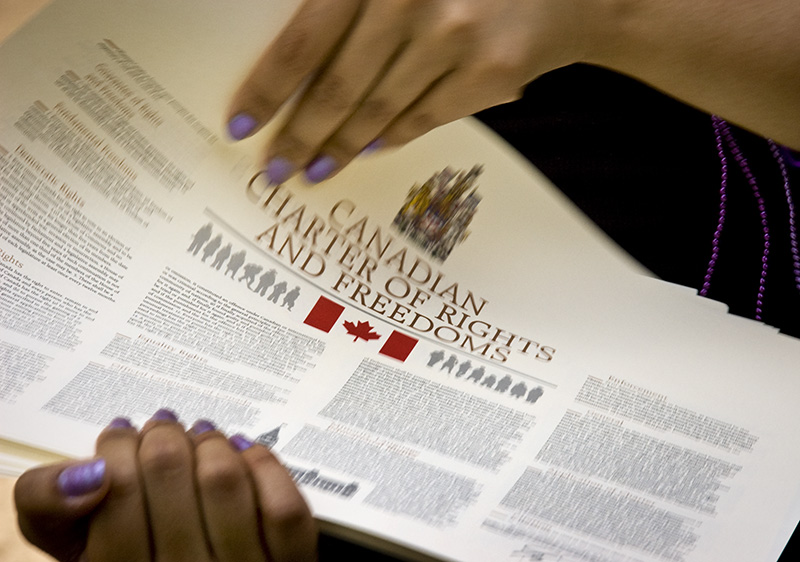
The Charter of Rights and Freedoms is the one of the most recognizable parts of Canada’s constitutional democracy. Signed in 1982 under the Trudeau administration (and following extensive negotiations), the Charter of Rights and Freedoms provides legal protection for citizens’ rights to free speech, religion, and freedom from discrimination by limiting government power.
(Some) Background
There had been previous attempts to create rights protections in Canadian history. After the atrocities of World War II, and in light of the federal government overriding fundamental freedoms using the War Measures Act, the Canadian Bill of Rights was enacted in 1960 to recognize a number of Canadians fundamental freedoms. However, while this was a step forward from having fewer rights recognized, the Canadian Bill of Rights was limited in its application; as a federal law, it didn’t apply to provincial governments and could be easily overridden.
In the 1980s, Prime Minister Pierre Trudeau and other political actors wanted to separate their power from the United Kingdom, making the Canadian constitution a document held in Canada. In addition to removing British control, Trudeau and his government wanted to add new rights protections to the Constitution, to ensure that Canadians would be protected against any unjust laws in a way that would extend to the provinces and could not easily be disregarded.
Changing the Constitution was not an easy process. The debate over patriation took place over many years. When Prime Minister Pierre Elliott Trudeau started the process, he began in part by asking the Supreme Court whether the consent of the provinces was needed. In the 1981, Patriation Reference the Supreme Court of Canada found that while it was in fact legal for the federal government to patriate the constitution without the consent of the provinces, it would be breaking with historical convention.
Rounds of negotiations with the provinces ensued, and during these talks, the idea of a “notwithstanding clause” that would enable provinces to override parts of the Charter to allow them to maintain legislative autonomy (while still signing on to a Charter and the patriation of the Constitution) emerged. In 1981, during the First Ministers’ Conference, a prominent group of politicians gathered to debate and draft the elements of a notwithstanding clause. Despite significant challenges and the exclusion of Quebec from the final document, ultimately most of the provinces engaged in a compromise that saw them agreeing both to sign on to patriating the Constitution and to include new rights protections through a new Charter of Rights and Freedoms.
The Charter and (Some) Notable Sections
The Charter is a document that grants Canadians and non-citizens residing in Canada certain protections, including democratic rights, freedom of expression, and legal or equality rights, among others. As part of the Constitution, it is a “supreme law of Canada,” and creates conditions limiting what governments can do or not do. To this end, all government actions and laws must be in accordance with the sections of the Charter. As a result, the Charter has directed the actions of government officials when developing and implementing policies.
Section 1
“The Canadian Charter of Rights and Freedoms guarantees the rights and freedoms set out in it subject only to such reasonable limits prescribed by law as can be demonstrably justified in a free and democratic society.”
s.1 of the Canadian Charter of Rights and Freedoms
When a government in Canada makes a law that violates the terms of the Charter, a court might say that doing so is legitimate, so long as the violation occurs in ways that are a “reasonable limit” that can be “demonstrably justified in a free and democratic society,” or in other words, saved under s.1. The Supreme Court of Canada developed a test in the landmark case of R. v. Oakes to assess what constitutes a reasonable limit, that involves a two-part to determine whether legislation violating the Charter can be justified under s.1.
In R. v. Oakes, the Supreme Court developed a two-part formula (the with three justificatory criteria to weigh the balance of power between the law in question and individuals’ freedom and rights. The first part of the test asks two foundational questions to establish the connection of the case to the use of the Charter effectively determining whether the limit on freedom is reasonable: 1) Is the legislative goal pressing and substantial and; 2) is there proportionality between the objective and the means used to achieve it?
After the first part of the test is established, the Court must engage in the second part of the Oakes test, that is, identifying whether that reasonable limit can be demonstrably justified in three ways. First, the aim of the law or policy under scrutiny must be rationally connected to the limit on the Charter right. Second, the limitation must restrict the Charter right as little as possible (i.e., minimal impairment). Third, there should be an overall balance or proportionality between the benefits of the limit and potential harmful effects.
One early and important application of the reasonable limits clause occurred in the case of R.v Keegstra. In this case, a teacher had handed out anti-Semitic posters at an Alberta high school, and was arrested and charged for with promoting hatred against an identifiable group. In court, Keegstra attempted to claim that his actions were justifiable under the freedom of expression provisions of the Charter. The Supreme Court found that although Keegstra was right–that the limitations on the promotion of hatred was a violation of the freedom of expression provisions of the Charter, after applying the Oakes test, the Court found that the restriction on Keegstra’s freedom of expression was reasonably justified under s.1 of the Charter.
In the context of a free and democratic society, the reasonable limits clause (s.1) serves as a safeguard for protecting human rights and limiting freedoms by balancing government power with individual liberty. However, this clause has been criticized for its ambiguous language, leaving what counts as “reasonable limits” up to the judiciary.
Section 2: Fundamental Freedoms
Section 2 of the Charter ensures that Canadian citizens are guaranteed “fundamental freedoms.” The section contains four sub-sections that specify which fundamental freedoms are protected, including the freedom to practice religion freely, speak freely, express opinions, meet with others, and form associations.
S. 2(a) guarantees “freedom of conscience and religion.” It ensures that Canadians have the ability to follow their beliefs and practice their religion freely without fear of retaliation. Although the courts have not explicitly defined “religion,” they have determined that the scope of the right extends to all connections of worship and faith, as well as the beliefs of atheists. As a cornerstone of Canadian values, Section 2(a) is instrumental in underpinning democracy and human rights, harmonizing the rights of individuals with the wider societal interest. A notable Supreme Court case involving s.2(a) is R v Big M Drug Mart Ltd.
S. 2(b) guarantees “freedom of expression,” which encompasses expressions of belief, opinion, and thought, including freedom of the press and other media of communication. This right extends to freedom of the press and other methods of communication which take place in the media. This subsection has been valued as a tool for ensuring democratic governance as it grants citizens the ability to determine their own truth and engage in unconstrained discussions of ideas. This does not mean that anyone can say or do anything at any time, and the Supreme Court has found that there are important limits (under s.1) on how far freedom of expression can go. A notable Supreme Court case involving s. 2(b) is R v. Butler.
S. 2(c) guarantees “freedom of peaceful assembly,” which ensures the right to participate in peaceful demonstrations, protests, parades, meetings, picketing and other assemblies. This freedom allows individuals to freely choose the location and the timing of the assembly. In comparison to the other subsections, s. 2(c) has received little or no attention over the last 40 years of Charter interpretation. However, there have been some cases, and usually cases that might be considered as matters for 2(c) are instead addressed under s.2(b) above. This is in part because there is not simply a right to assemble, but rather a right to peaceful assembly, and also there may be reasons (under s.1) to limit the right to gather in any place at a given time. Litigation during the Occupy movement around protesters right not to be evicted from a public park focused on freedom of peaceful assembly and freedom of expression.
Finally, s. 2(d), “freedom of association,” protects various forms of association, including trade unions, political groups, and commercial relationships, while also outlining limitations regarding compelled association and associations involving violence. This subsection serves to empower vulnerable groups, enabling them to address societal imbalances collectively. It ensures individuals can pursue their common goals without state-enforced isolation. Importantly, the courts have interpreted that the rights protected by 2(d) include a procedural right to collective bargaining, so any legislation or actions by the government that substantially interfere with this collective bargaining process can be considered a violation of section 2(d). A notable Supreme Court case involving s. 2(d) is Dunmore v Ontario.
Section 15: Equality Rights
Section 15(1) of the Charter ensures that every individual in Canada is “equal before and under the law” and has a “right to the equal protection and equal benefit of the law without discrimination.” The right explicitly states nine grounds on which discrimination cannot be based on, which are “race, national or ethnic origin, colour, religion, sex, age or mental or physical disability.”
S. 15(2) specifies that there can be exceptions made to the right, specifically when it comes to “ameliorative programs” or “affirmative action programs.” These are programs that are created by the government to help individuals of historically disadvantaged groups have equal opportunities.
As the right has been interpreted over the years, there have been additional grounds added. In Andrews v. Law Society of British Columbia, the judges ruled that the discrimination grounds listed in s. 15 were non-exhaustive. Instead, the nine explicitly stated are to be referred to as the enumerated grounds, whereas those not stated but should still receive equal protection, are called analogous grounds.
The Supreme Court of Canada stated that a characteristic can be ruled as an analogous based on a number of factors. These factors include:
- whether the characteristic has been subjected to historical discrimination;
- if the group that contains this characteristic lacks political power and influence;
- if an individual cannot change the characteristic or would face an “unacceptable cost to personal identity” to change; and
- if another human rights law has already accepted the characteristic as a prohibited ground of discrimination or if the characteristic is similar to other grounds already included in s. 15
Once a characteristic has been recognized as an analogous ground, it will always be viewed as such. Since the Andrews ruling, there have been several analogous grounds recognized, including citizenship, marital status and sexual orientation.
Section 25 (and 35): Aboriginal and Treaty Rights
In the early 1980s, the initial versions of the Charter in Canada overlooked Indigenous rights. Determined Indigenous groups, however, lobbied for their cause through initiatives like the Constitution Express, which introduced discussion for the inclusion and protection of their rights. Such efforts led to the inclusion of s. 35 of the Constitution Act, “Rights of the Aboriginal Peoples of Canada,” and s. 25 within the Charter, named “Aboriginal and treaty rights.”
Section 25 reaffirms the treaty rights under the Royal Proclamation of 1763 while protecting new rights and freedoms acquired by new land claim agreements. However, the section has received very little judicial consideration, which means that its purpose and scope are still uncertain. One notable exception occurred in R. v. Kapp. In this case, Justice Batastarache, writing a concurring opinion at the Supreme Court of Canada, outlines that s. 25 ought to shield Indigenous People by protecting their rights and taking priority over other sections of the Charter. This means that, regardless of whether principles in other areas of the Charter go against s. 25, it should not affect the courts’ ability to uphold Indigenous rights.
Section 35 of the Constitution Act of 1982 is not part of the Charter, but it is often read and understood alongside s.25 as it grants legal protections to the existing treaty rights and to the Indigenous Peoples of Canada, specifically acknowledging “Indians, Inuit, and Métis.” This section solidifies the recognition and affirmation of Indigenous status within Canada; however, Section 35 does not introduce novel rights or protections for the Indigenous community. Instead, they reaffirm and protect the principles that were established under the Royal Proclamation of 1793.
There are still inherent fears that sections of the Charter, such as s. 15(1), could threaten the distinct legal status programs offered to Indigenous peoples through the Indian Act. However, as of yet, no such challenges have been successful.
Section 33: The Notwithstanding Clause
“Parliament or the legislature of a province may expressly declare in an Act of Parliament or of the legislature, as the case may be, that the Act or a provision thereof shall operate notwithstanding a provision included in section 2 or sections 7 to 15 of this Charter.”
s.33 of the Canadian Charter of Rights and Freedoms
Section 33 of the Charter, the “notwithstanding clause” states that both the federal Parliament or provincial governments can enact legislation that violates some of the rights and freedoms of the Charter in certain situations, particularly where governments disagree with potential (or actual) judicial decisions. When a government invokes the notwithstanding clause, the legislation in question (and the use of the notwithstanding clause) must be reviewed every five years.
The notwithstanding clause can only be applied to legislation that goes against: s. 2, or the rights outlined in s. 7-15. Other sections, including those addressing democratic rights, mobility rights, language rights, minority language education rights, and the guaranteed equality of the sexes cannot be violated using the notwithstanding clause. Legislators are able to enact the notwithstanding clause without having to justify their actions, face judicial review, or proclaim which components of the legislation specifically dismiss rights and freedoms.
The notwithstanding clause has been used relatively infrequently since the Charter came into force and only by provincial governments. Much of the use of the notwithstanding clause has occurred in Quebec, where s.33 has historically been applied to legislation (including Bill 101) intended to protect and preserve the French language as the dominant language within Quebec. The more recent use of the notwithstanding clause to ensure that Bill 21 would not be overturned by the Supreme Court despite violating the Charter, has resulted in legal scholars questioning the extent to which s.33 violates fundamental freedoms under s. 2, the security of the person provisions under s.7, the equality provisions under s.15, as well as the gender equality provisions under s.28. In recent years, s.33 has been used more frequently by other provinces, such as Ontario and Saskatchewan.
Ultimately, s.33 allows Parliament or provincial governments to enact legislation that does not comply with rights and freedoms guaranteed by the Charter, allowing provinces (or Parliament) to make legislative decisions that violate certain sections of the Charter without being challenged in court. Despite federal politicians’ optimistic views that s.33 would not be used arbitrarily, or in ways that violate the rights of vulnerable groups, this is exactly how it has been used in some cases, particularly in relation to legislation which overrides the rights of immigrants and refugees, trans and non-binary youth, and various union workers.
Simply enshrining the rights of Canadians (and non-citizen residents), has had an important impact on Canadians. The Charter is viewed by Canadians as an important document and a significant part of our democracy. It enshrines the rule of law and ensures that no matter what government is in power, certain rights and freedoms will be protected (notwithstanding…).
Furthermore, the Charter has had an impact on Canadian courts by giving judicial officials greater power in interpreting the meaning of certain laws. Political matters related to the Charter must go through a process in which the legislative and judicial branches of government must communicate with one another; the government may pass a law that could be unconstitutional or seen to violate certain rights, and it is up to the court to decide whether the law can stand. If the law is overturned, the onus is on the legislative branch to revise the law.
Additional resources:
- Explainer on the Oakes test from the Centre for Constitutional Studies
- The Canadian Encyclopedia article on the notwithstanding clause
- Video from CBC Saskatchewan explaining the notwithstanding clause
Contributors: Charlize Hickey, Sebastian Failla, Annabelle Jewett, Marryum Kamal, Mais Kheir, Ana Maharana, Jonathan Morgan, Marissa Savoury, Andrew James Shortreed, Molly Stewart, Ted Ren, Tiago Roopchand, Maya Umakanthan, Lucia Ussia, and Meerra Vasuthevan
 Welcome to Canadian Politics